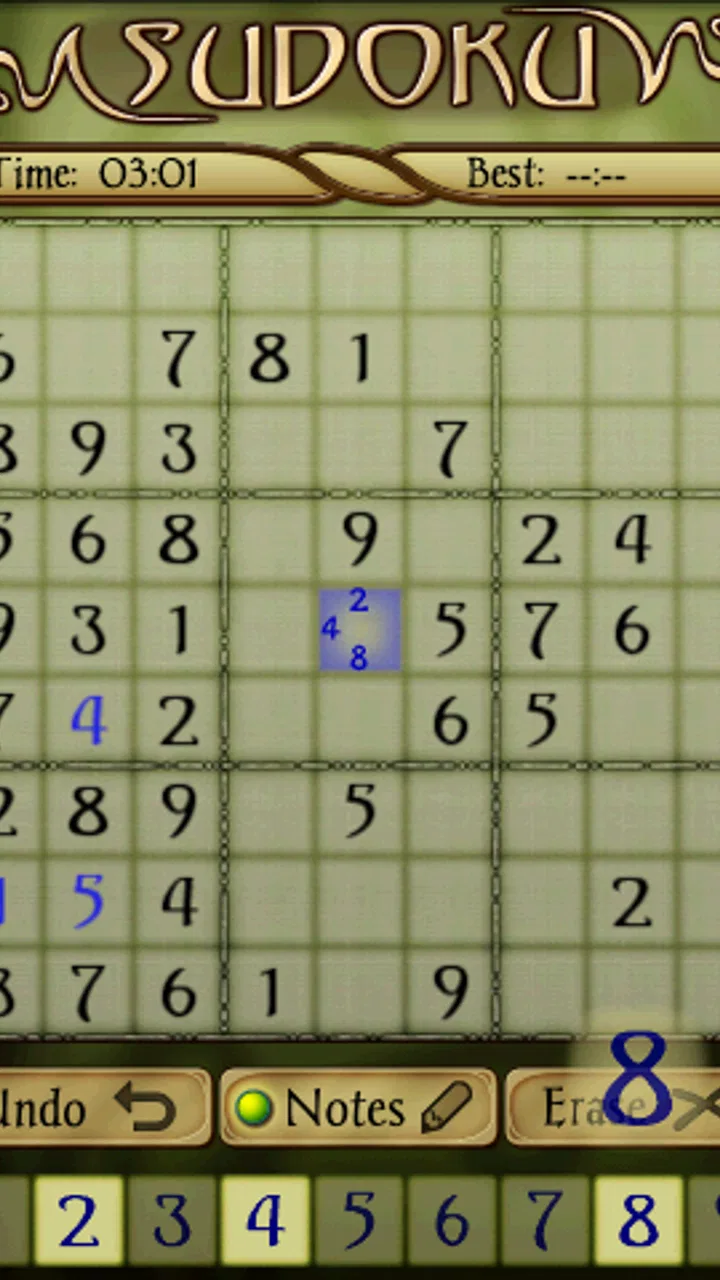
Sudoku Pro
- 4.7
- Rating
- 100.00K
- Installs
- $4.99
- Price
 Analysis by App-foxy
I enjoy Sudoku most when it gives me a clear mental task without turning a quiet break into a complicated event. Sudoku Pro takes that straightforward approach. It is a paid board game from AI Factory Limited, built around the familiar number-placement puzzle rather than extra distractions, social competition, or a large collection of unrelated modes. After spending time with it, I see its main appeal clearly: it offers a substantial supply of puzzles and a difficulty structure that makes it easy to begin gently and return when I want a more demanding session.
The game is aimed at people who already understand the basic rules of Sudoku or are willing to learn them through practice. Its store summary points to a large collection spread across five levels, and that promise shapes the whole experience. Instead of chasing a short burst of novelty, I found myself thinking in terms of routine: one puzzle during a coffee break, another while waiting somewhere, or a longer session when I wanted to concentrate. That makes it a particularly natural fit for a phone or tablet.
How the puzzle loop creates goals and momentum
I find the puzzle loop works best when I give each session a small, personal target: finish one grid without guessing, or make a careful start before a break ends. That keeps the challenge satisfying without turning Sudoku into a race, and it gives me a useful way to notice whether a level feels comfortable or genuinely demanding.
You May Also Like

 Blood Strike: 2.5 Anniversary
Blood Strike’s Loadouts Turn Every Drop Into a Tactical Gamble
A close look at Blood Strike’s custom loadouts: how fast access to signature weapons reshapes its battle royale rhythm, rewards preparation, and narrows the gap between fights.

 Pandora - Music & Podcasts
Pandora’s Music Is Easy to Start, but Harder to Recover
Pandora’s strength is its low-effort path from a seed to a station. Its weak spot is how much confidence it asks you to place in connection, setup, and quiet recovery.

 8 Ball Pool
 Is Built on Rivalries, Rematches, and Routine
A close look at the rivalries, rematches, shared routines, and unanswered safety questions that turn a quick pool match into a persistent mobile community.

 Samsung Music
’s Quiet Strength Is Playing What You Already Own
Its reach comes less from spectacle than from dependable access to a personal library. That simplicity is both the app’s strongest retention engine and its ceiling.

 AccuWeather: Weather Radar
AccuWeather Review: A Quick, Clear Forecast for Everyday Decisions
For everyday plans, the best forecast is the one you can understand quickly. AccuWeather makes rain timing, radar, and local conditions easy to act on, with a few trade-offs.

 Hill Climb Racing
Why Hill Climb Racing Still Turns Crashes Into One More Run
A tiny car, a bumpy hill and one more upgrade: Hill Climb Racing keeps resurfacing because its simple chaos makes every near-miss feel personal.
More From Our News Desk
View All News


A simple first goal that works immediately
The first goal is refreshingly obvious: complete the current grid. There is no need to understand a complicated progression system before playing, and the rules do not change from one puzzle to the next. I can open the game, choose a level that matches my mood, and start looking for useful numbers. That directness is one of its strongest qualities because it removes the setup time that often weakens casual puzzle games.
For a new player, the early objective is not necessarily speed. It is learning how to read the grid without guessing. I found it more satisfying to scan rows, columns, and smaller sections for missing possibilities, then gradually narrow the choices. The game’s value comes from that process of deduction. A completed board feels earned because each placement should follow from the information already visible rather than from luck.
More experienced players can create their own early goals. I might try to solve a puzzle without using a hint, avoid filling a number until its position is certain, or simply finish a familiar difficulty more efficiently than before. These are self-imposed targets rather than elaborate rewards, but they suit Sudoku well. The puzzle itself supplies the motivation, and the five-level structure gives those personal challenges somewhere to grow.
Why a large puzzle supply matters
The collection contains 2500 puzzles, which is enough to make the game feel like a long-term purchase rather than a short sample. I would not treat that figure as a promise that every puzzle will feel radically different; Sudoku is still built on the same underlying rules. What it does provide is room to build a habit without quickly exhausting the game’s central activity.
That quantity is especially useful when I want to keep difficulty separate from mood. I can choose a gentler puzzle when I am tired, then return to a harder one when I want a deeper concentration exercise. A smaller collection might force me to replay boards sooner, while this one gives the basic format more breathing room. The benefit is practical rather than flashy: there is usually another puzzle available when I am ready to continue.
There is also a useful psychological difference between having a large backlog and having only a few puzzles. With a broad collection, I do not feel that every mistake ruins my limited opportunity. I can abandon a grid that has become messy, reset my approach, and move on without treating the session as a failure. That makes experimentation less stressful, especially while learning how to use notes and candidate numbers effectively.
Progress signals without unnecessary noise
Sudoku does not need experience points or collectible prizes to show progress. The clearest signal is the puzzle I can now solve comfortably. A level that once demanded constant checking may eventually become a warm-up, while the next level starts to feel manageable. That gradual change in my own ability is more meaningful here than an artificial badge.
The five difficulty levels give that improvement a visible direction. I can begin with the level that lets me understand the interface and build confidence, then move upward when the current challenge stops requiring much thought. This is a better progression signal for a logic puzzle than a stream of rewards would be. It tells me what kind of reasoning the game expects next.
Still, the experience depends on whether I am willing to measure progress internally. Players who need frequent unlocks, animated celebrations, or a constantly changing reward track may find the structure quiet. The game’s progress is mainly in solving more demanding boards and becoming more disciplined with deduction. For me, that is enough, but it is important to know what kind of motivation the design favors.
Using each session as a small training exercise
I get more from the game when I treat a puzzle as a sequence of decisions rather than a race to fill empty squares. At the start, I look for obvious placements and numbers that have only one possible location in a row, column, or section. Once those are handled, I revisit the areas affected by each placement. This creates a natural rhythm: scan, place, rescan, and narrow.
A useful habit is to pause before entering a number that merely seems likely. Sudoku rewards certainty, and a premature guess can create errors much later. I prefer to use the early part of a puzzle to establish reliable information, then let those placements open new possibilities. This approach makes the easier levels feel like practice for the harder ones instead of separate content with no connection.
Another practical tip is to stop treating a difficult grid as something that must be completed in one sitting. If I reach a point where every open cell appears equally plausible, taking a break can be better than forcing progress. Returning with fresh attention often makes a pattern easier to see. The large collection supports this relaxed approach because I can leave one puzzle and try another without running out of things to do.
The five-level curve and what it feels like in use
The difficulty structure is the central pacing tool. Lower levels are useful for learning the board and building a steady solving routine. They also work well when I want a short, low-pressure activity. As I move upward, the puzzle demands more careful candidate tracking and a greater willingness to revisit earlier assumptions. The challenge becomes less about spotting immediate answers and more about managing several possibilities at once.
That curve is valuable because Sudoku can become frustrating when every puzzle begins at an expert level. Here, I can choose a starting point instead of being forced into the game’s idea of what a serious player should handle. A beginner can stay with the easier boards, while a practiced solver can use the upper levels as a more demanding test. The same app therefore supports different reasons for playing.
The trade-off is that difficulty labels are not a substitute for a detailed explanation of solving techniques. Someone moving from an easier level to a harder one may understand that the puzzle is tougher without immediately knowing why. The best way through is to slow down, use systematic notes, and avoid guessing. Players expecting a guided lesson in advanced Sudoku may prefer a dedicated tutorial-focused alternative.
Where the pacing is strong and where it is quiet
I like the pacing because it comes from the puzzles themselves. There is no artificial urgency pushing me to play another board immediately. A session can last only a few minutes or continue until the grid is complete, depending on how much attention I have available. That makes it suitable for everyday use, especially when I want something engaging but not noisy.
At the same time, the lack of external pressure means retention depends on personal interest. The game is not trying to pull me back with a narrative cliffhanger or a rotating event. If I enjoy improving my solving ability, the five levels and broad puzzle supply provide a durable reason to return. If I need constant novelty, the repeated format may feel too restrained after the initial appeal.
I think this is a deliberate strength rather than a missing feature. Sudoku works best when the challenge remains the focus. The game does not need to disguise the fact that I am solving number grids. Its pacing is closer to a book of puzzles than to a reward-driven mobile game, and that comparison explains both its calm appeal and its limited excitement outside the core activity.
A realistic everyday way to use it
Imagine having ten minutes before an appointment. I can open the game, select a comfortable level, and work through the opening deductions without needing sound, a story recap, or a multiplayer opponent. If the appointment arrives, the puzzle can simply become a stopping point in my day rather than a commitment to finish a timed round. Later, I can return to the same kind of activity when I have more concentration.
Another good situation is an evening when I want to reduce passive scrolling. A harder puzzle gives my attention a specific job, but it does not require the emotional investment of a competitive game. I can focus on one grid, make progress, and stop once my concentration fades. That balance is why I would recommend it to someone who wants a quiet mental workout rather than a constantly stimulating entertainment app.
Who will appreciate the paid format
The price is $4.99, so the important question is not whether the game is free to try but whether its focused design is worth paying for. I think the answer is more favorable for regular Sudoku players than for people who solve a grid only occasionally. The combination of five levels and 2500 puzzles gives frequent users a substantial reason to keep it installed.
Paying also changes how I judge the experience. I expect the basic puzzle loop to be polished, readable, and comfortable over repeated sessions. I do not need a parade of extras, but I do want the game to respect the time I put into solving. For someone who already knows they enjoy Sudoku, a one-time purchase can feel more sensible than choosing a free alternative that surrounds the same activity with distractions or a more aggressive retention model.
On the other hand, occasional players may be better served by a free Sudoku app or a newspaper puzzle. If I solve only one grid every few months, the collection may be more than I need. The paid format makes the most sense when I expect to return regularly and value having a dedicated board-game experience instead of treating Sudoku as a disposable pastime.
How it compares with common alternatives
Compared with a physical Sudoku book, this game is easier to carry and avoids the need for a pencil and eraser. It also makes switching between difficulty levels more convenient. A book can feel more satisfying for people who enjoy writing directly on paper, while the app is preferable when I want a compact option that is always close at hand.
Compared with free mobile Sudoku games, the main comparison is not the rules but the overall attitude. Many free alternatives compete through extra modes, daily tasks, visual themes, or monetization prompts. Sudoku Pro is more appealing if I want the board itself to remain central. A more feature-heavy competitor may be better for someone who wants statistics, social challenges, or a broader game ecosystem, but those additions can also make a simple puzzle feel busier.
It is also different from online Sudoku services that emphasize fresh community content or browser access. This game’s strength is its defined collection and straightforward mobile identity. If I need to play across many devices, share results, or compare times with other people, another option may fit better. If I want a dependable personal puzzle library, the focused approach is more convincing.
Practical expectations before installing
Sudoku Pro is rated for Everyone, and its minimum operating system is Android 6.0. Those details make it accessible to people using older compatible Android devices, while the current version is 2.44. The developer is AI Factory Limited, a name associated here with a focused board-game presentation rather than a sprawling entertainment platform.
The game has an average rating of 4.7 from around 2.6 thousand ratings, with more than 285 written reviews and over 100 thousand installs. I read those figures as signs that the basic concept has found a stable audience, not as proof that every player will share the same preferences. Ratings are most useful when matched with the right expectations: this is a dedicated Sudoku experience, not a broad puzzle suite.
Before choosing it, I would ask myself three things. Do I already enjoy traditional Sudoku? Am I comfortable paying for a focused game instead of looking for a free option? And do I prefer quiet, self-directed progress over rewards and social competition? If the answer to those questions is yes, the design is easy to understand and likely to fit naturally into a routine.
Where the experience may not be enough
The biggest limitation is also the game’s identity: it stays close to classic Sudoku. Players looking for branching goals, unlockable content, dramatic presentation, or a variety of puzzle types should look elsewhere. The five levels provide a useful challenge ladder, but they do not transform the format into something fundamentally different.
There is also a difference between having many puzzles and having endless variety. Even with a large collection, the solving process remains familiar. I appreciate that consistency, but I can imagine some players feeling that the game settles into a predictable routine. Taking breaks, changing difficulty, and setting personal solving goals helps, but those solutions come from the player rather than from a highly varied progression system.
Finally, the game is not the best match for someone who wants Sudoku explained from the ground up through a structured course. It can support learning through repeated play, but a beginner who wants detailed instruction on every advanced technique may find a teaching-oriented app more suitable. I would recommend starting at an easier level and building methodically rather than jumping straight into a difficult grid.
My progression verdict
After using it as a regular puzzle rather than chasing short-term rewards, I think Sudoku Pro sustains play through a sensible combination of early accessibility, visible difficulty steps, and a deep supply of boards. The goals are modest but appropriate: solve the current grid, improve your method, and move toward a level that once seemed out of reach. That pacing feels honest because it does not pretend that Sudoku needs a story or a reward economy to remain engaging.
The retention pressure is intentionally low. The app gives me reasons to return, but it does not demand that I do so at a particular time. For me, that is ideal. I can use it as a short concentration exercise, a quiet replacement for aimless scrolling, or a longer challenge when I have the patience to work through a demanding board. The experience remains consistent across those situations.
My recommendation is strongest for regular Sudoku players who want a focused, substantial board game on Android. I would skip it in favor of a free or more feature-rich alternative if I needed social play, advanced performance tracking, multiple puzzle types, or a guided learning course. But if the appeal is simply sitting down with a clean number puzzle and gradually taking on harder grids, this paid release offers a calm and practical way to do exactly that.
FAQs for Sudoku Pro
01What is Sudoku Pro, and how does the game work?
Sudoku Pro is a number-placement puzzle game based on the classic Sudoku rules. The objective is to fill a 9-by-9 grid so that every row, column, and 3-by-3 section contains the numbers one through nine without repetition. It is designed for both casual players and experienced puzzle fans, offering a focused way to practice logic, concentration, and problem-solving skills.
02Does Sudoku Pro include different difficulty levels?
Yes, Sudoku Pro is generally designed with multiple difficulty levels so players can choose a challenge that matches their experience. Beginners can start with easier boards to learn the rules, while advanced players can select harder puzzles that require more deduction and careful planning. The variety helps prevent the game from becoming repetitive after only a few sessions.
03Can I play Sudoku Pro without an internet connection?
Sudoku Pro is suitable for offline play in many versions, allowing you to solve puzzles without mobile data or Wi-Fi once the application has been installed. This makes it convenient for travel, commuting, or situations where the connection is unreliable. However, features such as advertisements, cloud synchronization, updates, or online statistics may require internet access.
04Does Sudoku Pro provide hints, notes, or error checking?
Most Sudoku Pro versions include helpful tools such as hints, pencil marks, and optional error checking. These features can make difficult puzzles more approachable, especially for new players who are still learning common solving techniques. Users should check the game settings because automatic error detection or unlimited hints may reduce the challenge and can sometimes be restricted or connected to premium features.
05Is Sudoku Pro free to download, and does it contain advertisements or in-app purchases?
Sudoku Pro may be available as a free download, although the exact pricing model depends on the Android or iOS version. Free editions commonly include advertising and may offer optional purchases for removing ads, unlocking additional puzzles, or accessing extra customization features. Before downloading, review the store listing and permissions so you understand any costs and the type of advertising included.
Pros
- Clean interface makes puzzles easy to read on small screens.
- Multiple difficulty levels suit both beginners and experienced players.
- Helpful hints can prevent frustration when you get stuck.
- Offline play is convenient when you have no internet connection.
- Quick puzzle sessions work well for commutes or short breaks.
Cons
- Some features may be restricted unless you upgrade or view ads.
- Hints can reduce the challenge for players seeking a pure experience.
- Limited visual variety may make extended sessions feel repetitive.
- Mistakes can be frustrating if there is no generous undo option.
- Competitive players may miss deeper statistics or online leaderboards.

Sudoku Pro
Gallery